The Problem for Athletes.
An ankle inversion injury can begin and end in as little as 40 milliseconds. The peroneal reflex — the body’s own protective response — often activates too late to prevent tissue damage. Existing solutions don’t solve this. Braces, tape, and compression wear provide passive, always-on support that restricts normal movement whether it’s needed or not. Sensing wearables collect data but can’t physically respond. That window — between when a roll happens and real protection has a chance to step in — has gone largely unaddressed. Until now.

Smart Ligament™ systems don’t observe—they respond.
Most sports wearables measure what happened. Smart Ligament™ systems are designed to act before damage occurs. LigaSys is building a new class of reactive wearable hardware that integrates into athletic garments, detects dangerous joint motion in real time, and mechanically engages to help protect the joint in the moment it matters.
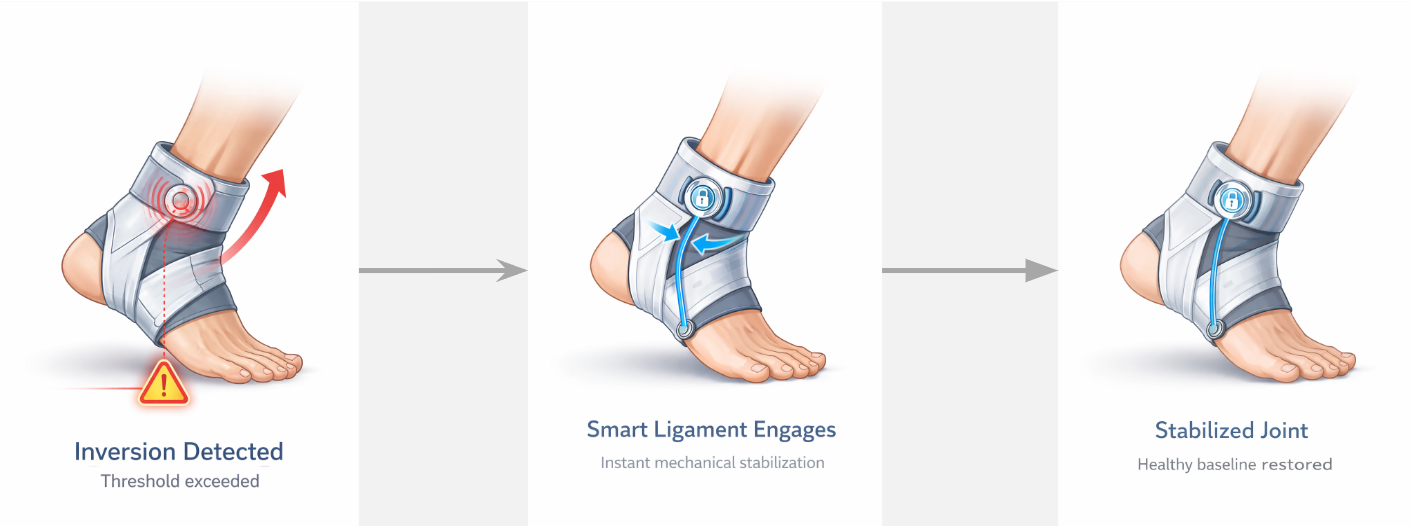
A new category of joint protection.
The Problem for Teams.
Ankle sprains cost the public health system $2-4 billion a year in treatment, rehab, and lost productivity. For an elite franchise, a single multi-week absence drains the payroll while the roster takes the field short-handed. When a max-contract NBA player misses an 11-game stretch to an ankle injury, the team pays out millions in dead salary for zero on-court return — before counting gate revenue, concessions and merchandise, and broadcast ratings. The injury is the same. The stakes just scale depending on who’s wearing the jersey. This cost has been treated as the price of doing business. It doesn’t have to be.

Smart Ligament™ systems don’t just protect players — they protect availability.
A player who isn’t on the field or on the court isn’t generating value — for the roster, the gate, or the broadcast. Smart Ligament™ systems are designed to reduce the frequency and severity of the injuries that drive unplanned absences, with the goal of keeping rostered athletes available when it counts most.
How Smart Ligament™ Compares
| Smart Ligament™ |
Brace | Tape | Sensing Wearables |
|
|---|---|---|---|---|
| Restricts normal movement | – | ✓ | ✓ | – |
| Responds during the injury event | ✓ | partial | – | – |
| Garment-integrated | ✓ | – | – | varies |
| Athlete-transparent during play | ✓ | – | partial | ✓ |
| Requires reapplication | – | – | ✓ | – |
| Collects motion data | ✓ | – | – | ✓ |
Beyond the ankle
Smart Ligament™ technology is not specific to any one joint. The underlying architecture — sensing dangerous motion, deciding in real time, and mechanically intervening — is designed to be adaptable across joints, sports, and form factors. The ankle is our first proof point and RiteFoot™ is our flagship implementation, chosen because ankle inversion injuries are common, costly, and well-understood. But the platform's value extends beyond any single product.
We're building LigaSys to be the underlying technology layer for reactive joint protection — one that sports equipment companies, apparel brands, and performance organizations can build on rather than recreate. If you're exploring what this could mean for your athletes, your gear, or your organization, we'd like to talk.